
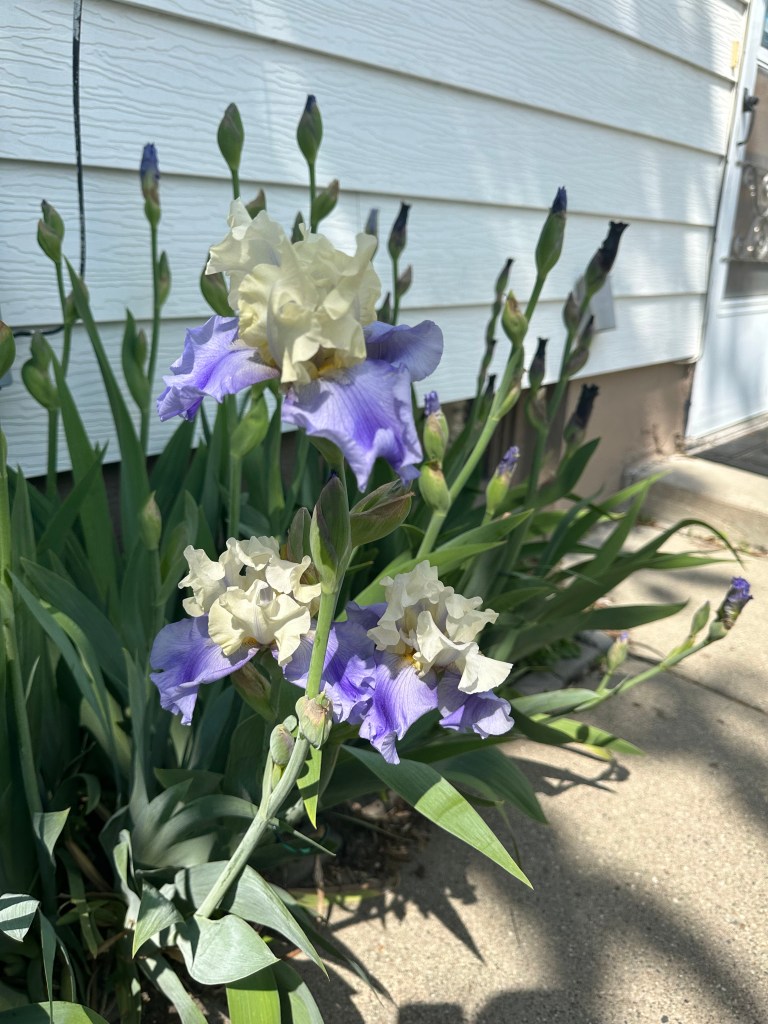
“Then the Lord God took the man and put him into the garden of Eden to cultivate it and keep it.” -Genesis 2:15
For as long as I can remember my family has had gardens. We had flower gardens, vegetable gardens, we explored the wild gardens on family hikes & enjoyed the beauty of community gardens. The experience of having our hands in the dirt and working for what we were going to enjoy later was an experience ingrained into the patterns of life.
This past weekend we spent some time at my In-Law’s and in some of the down time that I had I went out into the flower garden and was weeding. As a part of my doing that, my mother-in-law asked me “what is it that you enjoy so much about gardening?” And it got me thinking…
“what is it that you enjoy so much about gardening?”
So much of the joy of gardening is in the process. When you talk to someone who is a perennial gardener (the plants come back year after year) there never really is an end point. Sure, you have the beautiful moments of blossom or harvest, but there’s always something else to be done, to prepare for what’s next.
Sometimes in church I wonder if we miss the process. We’re so results oriented in our measurements (how many butts in the pews, how many dollars in the offering plate, how many students in Sunday School, etc.) that I wonder if we miss the process & forget to enjoy the steps along the way.
The purpose of the church is not to have the biggest congregation & the largest budget, on the block, in the community, in the country, etc. The purpose of the church is to share the Gospel so that those who haven’t experienced the good news can know that reality for themselves. Where is it that we miss the process of being the church, when all we care about is some “next harvest” calculation that pulls us away from being present in the moment?
One of the greatest joys of gardening is being able to craft your own workmanship. There is no final right or wrong way to do gardening. Everything that you do may have positive or negative impacts on the larger goal of what you’re trying to accomplish, but everything you do is also usually reversible. Plants that are planted and don’t fit can be pulled out. Pruning that goes too far will eventually grow back. Everything is your canvas to do as you want within that space & it’s freeing.
Everything is your canvas to do as you want within that space & it’s freeing.
So often in the church we’re unwilling to try new things, because we worry that we’re going to be stuck doing that experiment for the next 45 years. If the church could learn anything from gardening I wish that we could see the beauty in the ways in which new blooms require experiments (and sometimes failures) before we get something that’s worth keeping “forever”.
How is it that we as Church can take some of those new risks? What would it take for church leadership to feel free to have their own canvas, knowing that sometimes there will be things that will need to be pulled out and new plantings made? Where is it that we need to prune back the out of control bushes (or weeds) to allow for the church to bloom more fully again?
There’s nothing more fulfilling than seeing a finished project, but that doesn’t mean it’s the end of the work. There’s joy in seeing a garden that has been weeded down to the dirt, there’s only the flowers you planted, or the vegetable plants that you’ve tended to. But just because you complete the work of weeding one time doesn’t mean that your work of weeding is over. Just because you’ve pruned the bushes back this year doesn’t mean that they won’t be overgrown again next year, or the year after.
Our work is one that is one worth celebrating. God is doing amazing things in our midst, and in our congregations! But just because we succeeded (and hopefully celebrated too) our accomplishments doesn’t mean that we are done with the work. Our work is always one that will need a new commitment to the new work that is around us. We cannot rest on what has been done in the past, a new project awaits us every step we take along our journey.

 Imagining a Changing Church